
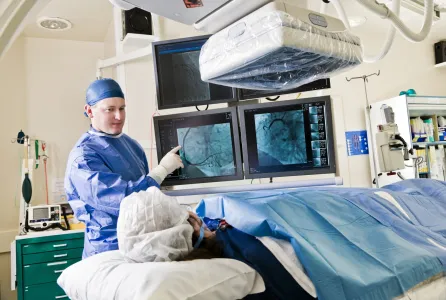
Interventional radiology is now one of the major advances in modern medicine.
Over the past decade, the scope of interventional radiology has continued to expand to include minimally invasive, medical-imaging-guided treatments for vascular, oncological, gastrointestinal, hepatobiliary, urogenital, musculoskeletal, gynecological, and neurological conditions. The technique of vascular embolization is included in this range of therapeutic procedures.
Interventional radiology is a medical specialty that combines medical imaging (X-rays, CT scans, ultrasound, MRI) with therapeutic procedures performed using minimally invasive techniques.
Embolisation : definition, principe et applications medicales | Cochin AP-HP Paris
Morgan R.A. et al., Global Statement Defining Interventional Radiology, CardioVascular and Interventional Radiology, 2024
Global Statement Defining Interventional Radiology—Have We Reached the Tipping Point? - PMC
Understanding Vascular Embolization
Vascular embolization involves blocking a blood vessel by intentionally introducing an embolic agent to alter or interrupt blood flow to a target area. The procedure is performed by a specialist physician, the interventional radiologist, who uses various medical devices during the procedure, including microcatheters inserted into the vascular network, under real-time imaging guidance that allows the targeted area for embolization to be reached.
The objective may be to:
• stop bleeding,
• reduce or eliminate blood supply to pathological tissue,
• or correct a blood circulation abnormality.
This approach allows for precise intervention while preserving the surrounding healthy tissue.
Chabrot P., Boyer L. Embolisation. Springer Verlag France, 2012
Vascular Embolization: A Versatile Therapeutic Approach
Vascular embolization can be used either as a minimally invasive alternative to surgery for certain indications or as an integral part of a multimodal treatment strategy, including preoperative, adjuvant, or palliative treatments.
Compared to conventional surgery, for certain conditions, embolization may offer advantages, such as:
• a minimally invasive procedure, thus avoiding major incisions,
• reduced postoperative pain for some patients,
• shorter hospital stays for most procedures
These factors help explain why embolization has been incorporated into European medical guidelines for a number of indications.
Becker L.S. et al. Intraarterial embolizations in life threatening hemorrhage. Emergency Radiology, 2023 [pmc.ncbi.nlm.nih.gov]
Applications of Vascular Embolization
1. Treatment of Bleeding
One of the traditional indications for embolization is the management of acute bleeding, whether of gastrointestinal, pulmonary, gynecological, or traumatic origin.
In these emergency situations, imaging often allows for the identification of the vessel responsible for the bleeding. Embolization then enables rapid occlusion of blood flow, which can be critical for patient management in what is typically a life-threatening situation.
Kettenbach J. et al. CIRSE Standards of Practice on Bronchial Artery Embolisation. Cardiovascular and Interventional Radiology, 2022 [cirse.org]
Gambhir M. et al. Uterine artery embolization in obstetric hemorrhage. Journal of Obstetrics and Gynaecology India, 2022 [pmc.ncbi.nlm.nih.gov]
2. Venous diseases: varicose veins and varicocele
Embolization is frequently used in the treatment of certain venous diseases:
• Varicocele: abnormal dilation of the testicular veins, common in young men and sometimes associated with pain or fertility issues. Embolization allows for the closure of diseased veins, yielding favorable clinical outcomes in some cases without the need for surgery.
• Pelvic or lower limb varicose veins: in selected cases, embolization can provide long-term relief of symptoms by interrupting the abnormal venous circuits responsible for pain or discomfort.
LIerardi A.M. et al. CIRSE Standards of Practice on Varicocele Embolisation. Cardiovasc Intervent Radiol, 2022 [cirse.org]
Lee B.B. et al. International Union of Angiology Consensus on vascular malformations. Int Angiol, 2013 [link.springer.com]
3. Benign Prostatic Hyperplasia*
In men, benign prostatic hyperplasia is a common condition associated with an increase in prostate size as men age, leading to urinary symptoms that can sometimes be severe.
Prostatic artery embolization aims to reduce blood flow to the prostate, which gradually leads to a decrease in its volume and an improvement in symptoms. This technique offers a minimally invasive alternative to surgery, particularly for frail patients or those wishing to avoid major surgery.
Naidu S.G. et al. Prostate Artery Embolization—Review of Indications, Techniques and Results. Journal of Clinical Medicine, 2021 [pmc.ncbi.nlm.nih.gov]
Atkuri P. et al. Prostatic Artery Embolization: Systematic Review. Arab Journal of Interventional Radiology, 2025 [thieme-connect.com]
4. Vascular Anomalies and Malformations
Some people have arteriovenous malformations, fistulas, or other abnormalities of the blood circulation, which are sometimes congenital. These conditions can cause pain, bleeding, or functional problems.
Embolization allows for the selective correction of these abnormal blood flow pathways, often in multiple stages, and is highly adaptable to complex anatomical situations.
Chabrot P., Boyer L. Occlusions vasculaires et embolisations parenchymateuses. Springer, 2012 [link.springer.com]
CIRSE Standards of Practice – Vascular malformations and pseudoaneurysms [cirse.org]
5. Oncology and Targeted Therapies
In oncology, embolization may be used in certain situations and depending on the type of tumor to help:
• reduce blood flow to a tumor,
• relieve certain symptoms,
• or complement other treatments (surgery, chemotherapy, radiation therapy).
Depending on the case, it may be used as part of certain treatment strategies, in conjunction with other treatments.
Lucatelli P. et al. CIRSE Standards of Practice on Hepatic Transarterial Chemoembolisation. Cardiovasc Intervent Radiol, 2021 [cirse.org]
Bilhim T. et al. CIRSE Standards of Practice on Portal Vein Embolization. Cardiovasc Intervent Radiol, 2024 [pubmed.ncb...lm.nih.gov]
IN SUMMARY: The Essential Role of Medical Imaging
The success of embolization depends on the continuous use of medical imaging. In particular, this allows the physician to:
• visualize the vessels to be treated in a targeted manner,
• monitor the spread of the embolization agent,
• adjust the procedure in real time,
• and immediately confirm occlusion of the targeted vessel.
Imaging is thus a critical component for the successful and safe performance of these procedures.
More precise, gentler, and personalized medicine
Vascular embolization is part of a shift in medical practices toward treatments that are:
• targeted,
• tailored to each patient’s anatomy and pathology,
• and performed using less invasive techniques.
By combining medical expertise with increasingly advanced medical imaging, interventional radiology can, in certain indications, help improve patients’ quality of life while addressing the challenges of safety and efficacy in patient care.
Important Information:
The information presented in this article is provided for informational purposes only and is not a substitute for the advice of a healthcare professional.
Vascular embolization is a medical procedure that must be evaluated on a case-by-case basis by a healthcare professional. Like any medical procedure, it has benefits, risks, and limitations, and outcomes may vary depending on the patient and the clinical situation.
Indications, practices, and treatment availability may vary by country and local medical guidelines.
WF PROM : E26004444 MAY 2026